Research Projects
Title: Effect of Porosity on Shock Interaction with a Rigid, Porous Barrier
Sponsor: Rutgers University
Student: Hadassah Naiman
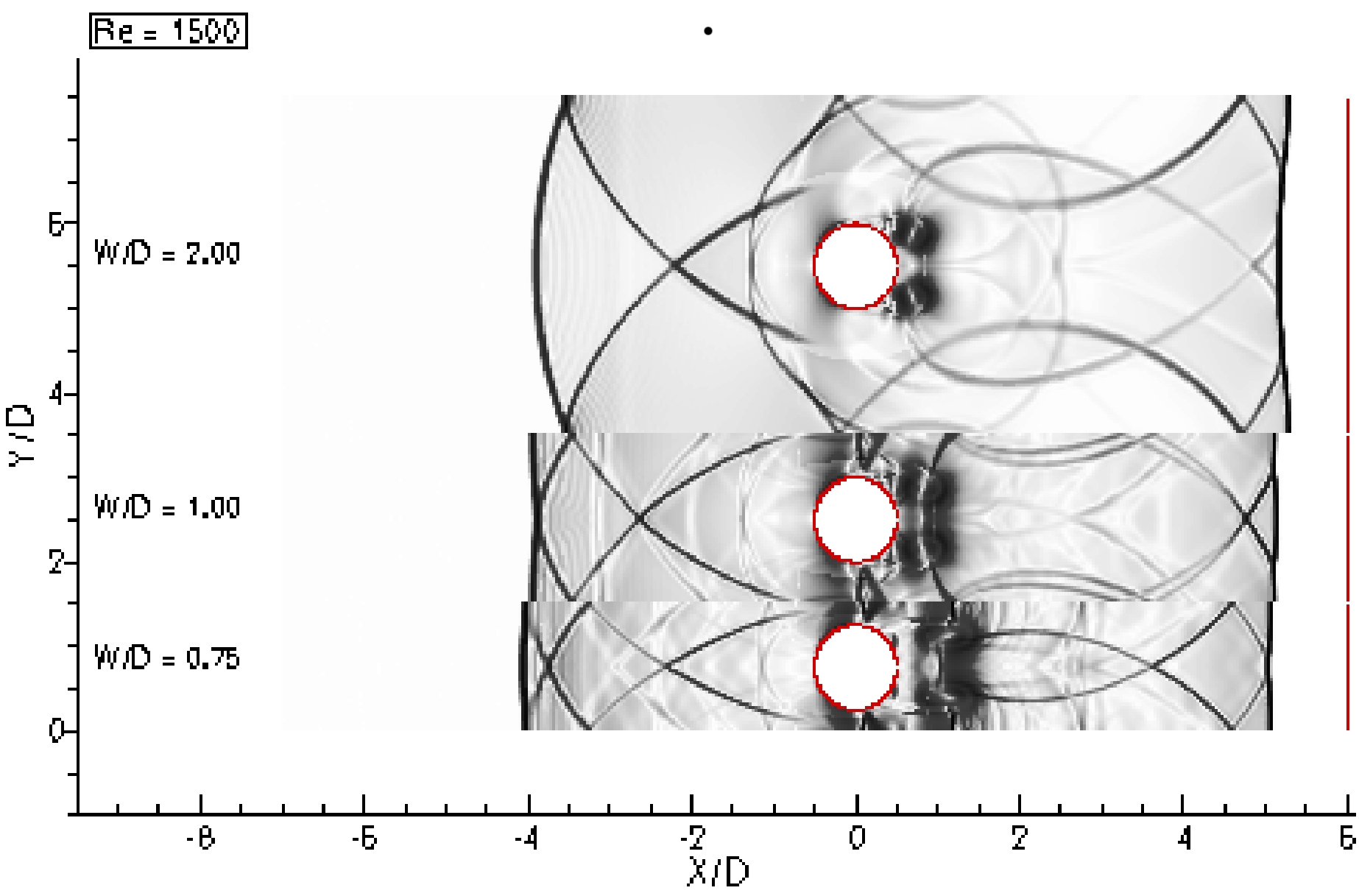 This work investigates the pressure amplification experienced behind a
rigid, porous barrier that is exposed to a planar shock. Numerical
simulations are performed in two dimensions using the full
Navier-Stokes equations for a Mach 1.3 incoming shock wave. An array
of cylinders is positioned at some distance from a solid wall and the
shock wave is allowed to propagate past the barrier and reflect off
the wall. Pressure at the wall is recorded and the flowfield is
examined using numerical schlieren images. This work is intended to
provide insight into the interaction of a shock wave with a cloth
barrier shielding a solid boundary, and therefore the Reynolds number
is small (Re=500 to 2000). Additionally, the effect of porosity of the
barrier is examined. While the pressure plots display no distinct
trend based on Reynolds number, the porosity has a marked effect on
the flowfield structure and endwall pressure, with the pressure
increasing as porosity decreases until a maximum value is reached.
This work investigates the pressure amplification experienced behind a
rigid, porous barrier that is exposed to a planar shock. Numerical
simulations are performed in two dimensions using the full
Navier-Stokes equations for a Mach 1.3 incoming shock wave. An array
of cylinders is positioned at some distance from a solid wall and the
shock wave is allowed to propagate past the barrier and reflect off
the wall. Pressure at the wall is recorded and the flowfield is
examined using numerical schlieren images. This work is intended to
provide insight into the interaction of a shock wave with a cloth
barrier shielding a solid boundary, and therefore the Reynolds number
is small (Re=500 to 2000). Additionally, the effect of porosity of the
barrier is examined. While the pressure plots display no distinct
trend based on Reynolds number, the porosity has a marked effect on
the flowfield structure and endwall pressure, with the pressure
increasing as porosity decreases until a maximum value is reached.
Title: Analysis of Purdue Quiet Tunnel Expansion Test Section
Sponsor: Air Force Office of Scientific Research
Student: Hadassah Naiman
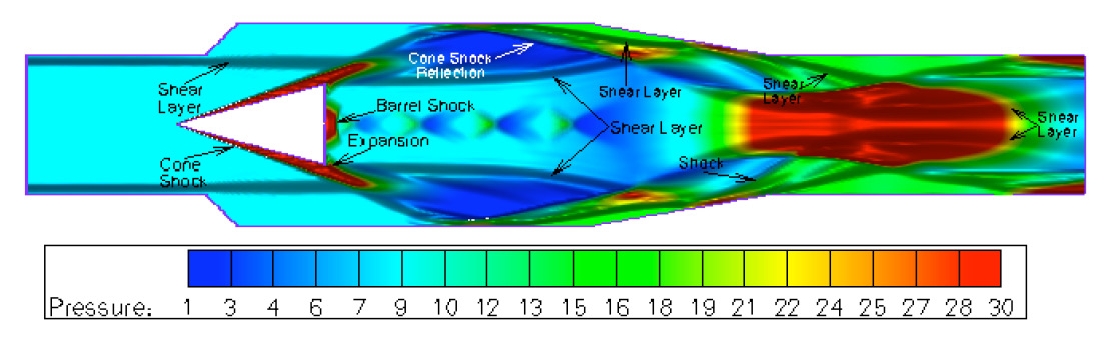 A proposed modification of the test section in the Boeing/AFOSR Mach 6
Quiet Tunnel at Purdue University is evaluated using CFD. The new
design incorporates a section of increased diameter with the intention
of enabling the tunnel to start in the presence of larger blunt
models. Cone models with fixed base diameter (and hence fixed
blockage ratio) are selected for this study. Cone half-angles from 15
deg to 75 deg are examined to ascertain the effect of the strength of
the test model shock wave on the tunnel startup. The unsteady,
laminar, compressible, laminar Navier Stokes equations are solved.
The resulting flowfields are examined to see what effect the shocks
and shear layers would have on the quiet test section flow. This
study indicates that cone angles less than or equal to 20 deg allow
the tunnel to start.
A proposed modification of the test section in the Boeing/AFOSR Mach 6
Quiet Tunnel at Purdue University is evaluated using CFD. The new
design incorporates a section of increased diameter with the intention
of enabling the tunnel to start in the presence of larger blunt
models. Cone models with fixed base diameter (and hence fixed
blockage ratio) are selected for this study. Cone half-angles from 15
deg to 75 deg are examined to ascertain the effect of the strength of
the test model shock wave on the tunnel startup. The unsteady,
laminar, compressible, laminar Navier Stokes equations are solved.
The resulting flowfields are examined to see what effect the shocks
and shear layers would have on the quiet test section flow. This
study indicates that cone angles less than or equal to 20 deg allow
the tunnel to start.
Title: Automated Optimal Design of Quiet Flow Hypersonic Wind Tunnels
Sponsor: US Air Force Office of Scientific Research
Student: Hadassah Naiman
 One of the major challenges in hypersonic flow research is the
accurate prediction of transition. The location and extent of
laminar-turbulent transition is a critical parameter in hypersonic
vehicle design due to its significant effect on predictions of
aerodynamic heating, skin friction drag and other boundary layer
properties. Most of the experimental data obtained from ground test
facilities are contaminated by the high levels of noise that radiate
from the turbulent boundary layers normally present on the nozzle
walls. These high noise levels can cause transition to occur an order
of magnitude earlier than in flight where rms pitot pressure
fluctuations are typically less than 0.1%. Quiet flow wind tunnels
have been developed to simulate hypersonic flow in flight by
maintaining laminar boundary layers on the nozzle walls. The
Boeing/AFOSR Mach-6 Quiet Tunnel (BAM6QT) at Purdue University was
constructed during 1995-2001 to study transition at Mach 6. It was
designed to achieve quiet flow at a stagnation pressures of 150 psi
and Reynolds number of 13 million. The objectives of our research
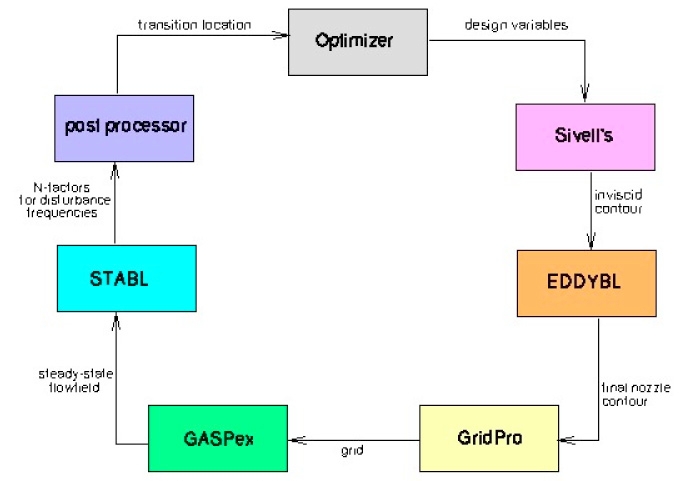
program, initiated in March 2006, are to apply modern CFD and design
optimization tools to 1) extend the capabilities of the BAM6QT, and 2)
develop a reliable, rational methodology for prediction, understanding
and design of quiet flow wind tunnels.
One of the major challenges in hypersonic flow research is the
accurate prediction of transition. The location and extent of
laminar-turbulent transition is a critical parameter in hypersonic
vehicle design due to its significant effect on predictions of
aerodynamic heating, skin friction drag and other boundary layer
properties. Most of the experimental data obtained from ground test
facilities are contaminated by the high levels of noise that radiate
from the turbulent boundary layers normally present on the nozzle
walls. These high noise levels can cause transition to occur an order
of magnitude earlier than in flight where rms pitot pressure
fluctuations are typically less than 0.1%. Quiet flow wind tunnels
have been developed to simulate hypersonic flow in flight by
maintaining laminar boundary layers on the nozzle walls. The
Boeing/AFOSR Mach-6 Quiet Tunnel (BAM6QT) at Purdue University was
constructed during 1995-2001 to study transition at Mach 6. It was
designed to achieve quiet flow at a stagnation pressures of 150 psi
and Reynolds number of 13 million. The objectives of our research
program, initiated in March 2006, are to apply modern CFD and design
optimization tools to 1) extend the capabilities of the BAM6QT, and 2)
develop a reliable, rational methodology for prediction, understanding
and design of quiet flow wind tunnels.
Title: Electromagnetic Local Flow Control using Microwave Pulse
Sponsor: US Air Force Office of Scientific Research
Faculty: Doyle Knight
 Electromagnetic} Local Flow Control (ELFC) in high speed flows has
emerged as a potential alternative to conventional flow control
techniques. A wide variety of technologies are investigated for ELFC
including DC discharge, Dielectric Barrier Discharge (DBD), laser,
microwave and combined laser/microwave. Pulsed microwave-generated
plasmoids in particular have been shown experimentally to achieve
significant drag reduction in supersonic flow past blunt bodies.
Moreover, the power expended for the pulsed microwave is substantially
less than the power savings associated with the drag reduction,
thereby achieving high energy efficiency. A complete gas dynamic model
of microwave energy deposition in air with full thermochemistry has
been developed by our team of researchers at Rutgers University (USA),
the Institute of High Temperatures (Moscow, Russia) and St. Petersburg
State University (St. Petersburg, Russia). The software is denoted
the Gas Dynamic Kinetic (GDK) code. The model includes 23 species and
234 reactions. The kinetic model has been validated through
comparison with experimental data at the Institute for High
Temperatures. The GDK code has been applied to the simulation of the
interaction of a microwave plasmoid with a hemisphere cylinder at Mach
2.1. The freestream static pressure and static temperature are 26
Torr and 154 K, respectively. The cylinder diameter D is 2 cm. The
microwave frequency $f$ is 9 GHz with a maximum electric field of 2.3
kV/cm and pulse duration of 1.2 mcs. The focal point for the
microwave pulse is 2.5 cm upstream of the center of the
hemisphere. The flow conditions and microwave parameters correspond to
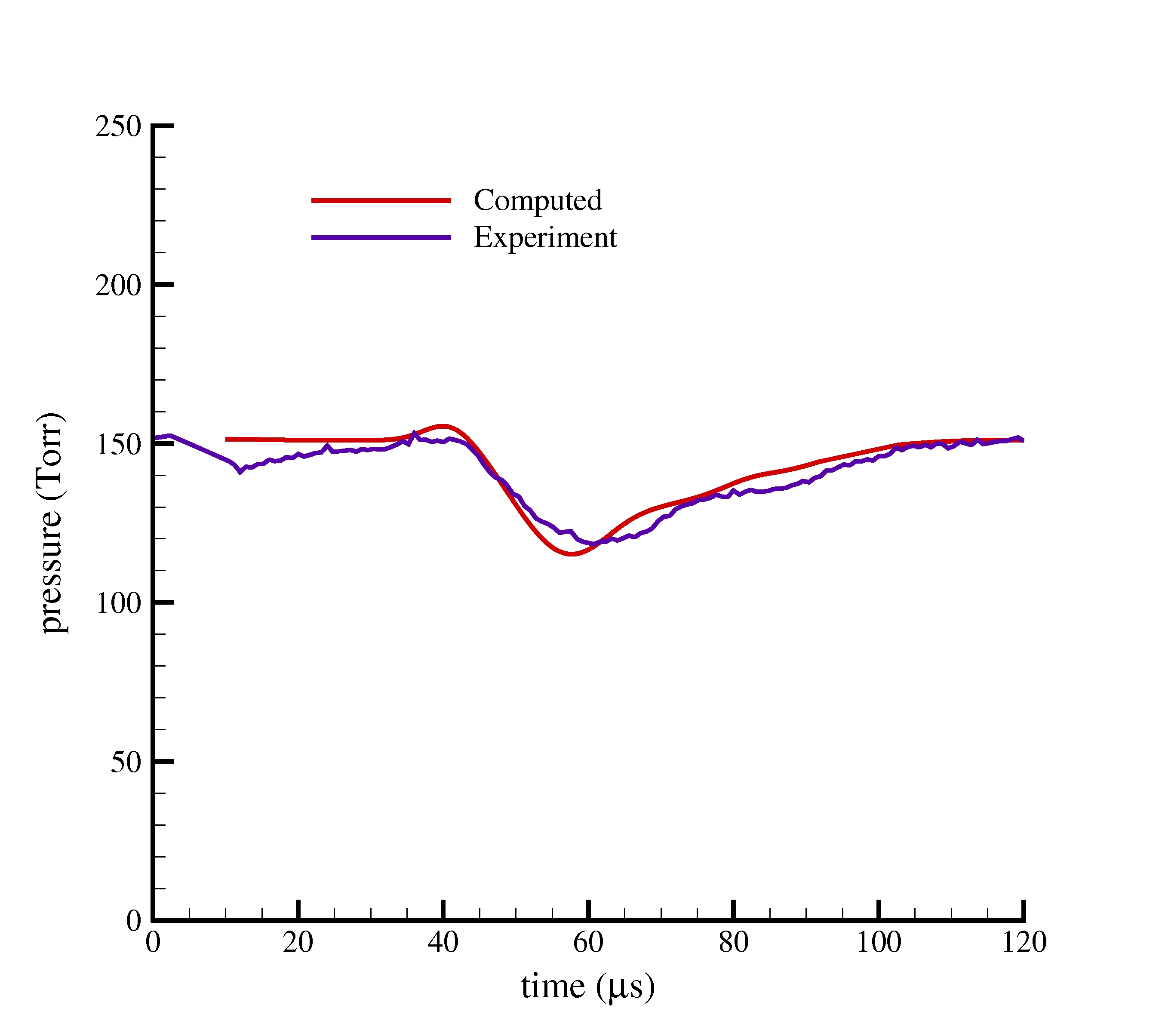
experiments performed at St. Petersburg State University. The figure
displays the computed and experimental surface pressure on the
centerline of the hemisphere surface vs time. Excellent agreement is
observed.
Electromagnetic} Local Flow Control (ELFC) in high speed flows has
emerged as a potential alternative to conventional flow control
techniques. A wide variety of technologies are investigated for ELFC
including DC discharge, Dielectric Barrier Discharge (DBD), laser,
microwave and combined laser/microwave. Pulsed microwave-generated
plasmoids in particular have been shown experimentally to achieve
significant drag reduction in supersonic flow past blunt bodies.
Moreover, the power expended for the pulsed microwave is substantially
less than the power savings associated with the drag reduction,
thereby achieving high energy efficiency. A complete gas dynamic model
of microwave energy deposition in air with full thermochemistry has
been developed by our team of researchers at Rutgers University (USA),
the Institute of High Temperatures (Moscow, Russia) and St. Petersburg
State University (St. Petersburg, Russia). The software is denoted
the Gas Dynamic Kinetic (GDK) code. The model includes 23 species and
234 reactions. The kinetic model has been validated through
comparison with experimental data at the Institute for High
Temperatures. The GDK code has been applied to the simulation of the
interaction of a microwave plasmoid with a hemisphere cylinder at Mach
2.1. The freestream static pressure and static temperature are 26
Torr and 154 K, respectively. The cylinder diameter D is 2 cm. The
microwave frequency $f$ is 9 GHz with a maximum electric field of 2.3
kV/cm and pulse duration of 1.2 mcs. The focal point for the
microwave pulse is 2.5 cm upstream of the center of the
hemisphere. The flow conditions and microwave parameters correspond to
experiments performed at St. Petersburg State University. The figure
displays the computed and experimental surface pressure on the
centerline of the hemisphere surface vs time. Excellent agreement is
observed.
Title: Interaction of Microwave Filament with Blunt Body in Supersonic Flow
Sponsor: US Air Force Office of Scientific Research
Student: Farnaz Farzan
 Pulsed microwave energy has been demonstrated experimentally to reduce
drag of aerodynamic bodies in supersonic flow. The principal
mechanism is the interaction of the thin hot plasma filaments with the
blunt body shock which lead to the effective streamlining of the body
through creation of a separation region ahead of the body. The
interaction of finite filaments with the shock layer formed ahead of a
blunt cylinder is examined using the unsteady Euler equations. The
basic phenomena explaining the flow structure are 1) modification of
the shape of the bow shock (lensing effect), 2) generation of toroidal
vortex region, 3) formation of stagnation point and consequent
aerodynamic streamlining of the body, 4) convection of the vortex
region past the cylinder
Pulsed microwave energy has been demonstrated experimentally to reduce
drag of aerodynamic bodies in supersonic flow. The principal
mechanism is the interaction of the thin hot plasma filaments with the
blunt body shock which lead to the effective streamlining of the body
through creation of a separation region ahead of the body. The
interaction of finite filaments with the shock layer formed ahead of a
blunt cylinder is examined using the unsteady Euler equations. The
basic phenomena explaining the flow structure are 1) modification of
the shape of the bow shock (lensing effect), 2) generation of toroidal
vortex region, 3) formation of stagnation point and consequent
aerodynamic streamlining of the body, 4) convection of the vortex
region past the cylinder
Title: Interaction of Microwave Filament with Blunt Body in Supersonic Flow
Sponsor: US Air Force Office of Scientific Research
Student: Kellie Norton
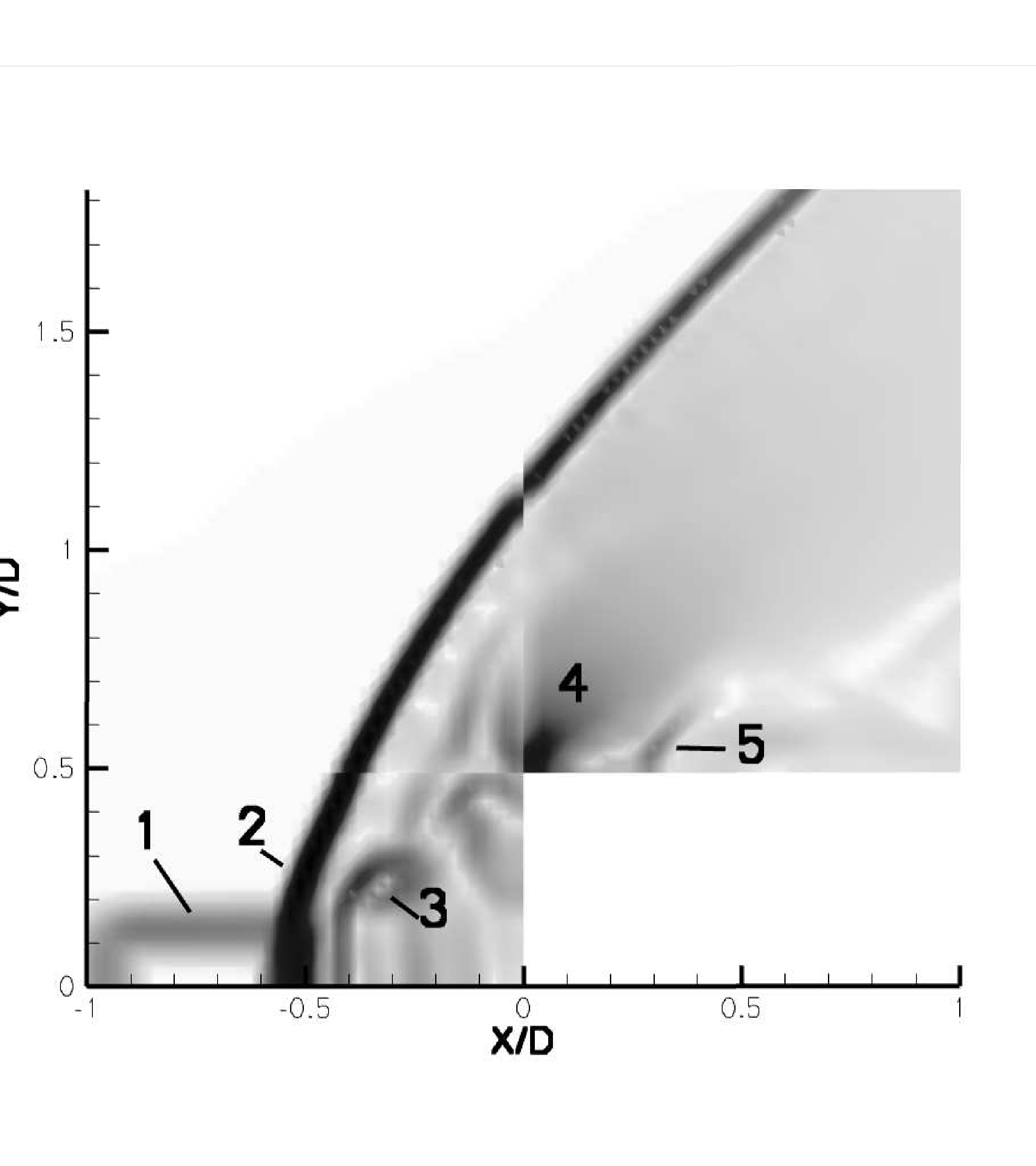 Recent experiments have demonstrated the capability of pulsed
microwave energy deposition for drag reduction in supersonic flows.
The principal mechanism of this phenomenon is the interaction of the
hot filaments generated by the microwave energy pulse with the shock
system formed by the aerodynamic body. In this paper, the filament is
modeled as a thin fluid region of high temperature. The interaction
of the filaments with a cylindrical body at in Mach 1.89 flow is
examined using the compressible Navier Stokes equations. This study
is an advancement of the inviscid simulations of pulsed energy
deposition in supersonic flow performed by Farzan (2008). For the
present research, a code is developed which includes viscous and heat
transfer effects.
Recent experiments have demonstrated the capability of pulsed
microwave energy deposition for drag reduction in supersonic flows.
The principal mechanism of this phenomenon is the interaction of the
hot filaments generated by the microwave energy pulse with the shock
system formed by the aerodynamic body. In this paper, the filament is
modeled as a thin fluid region of high temperature. The interaction
of the filaments with a cylindrical body at in Mach 1.89 flow is
examined using the compressible Navier Stokes equations. This study
is an advancement of the inviscid simulations of pulsed energy
deposition in supersonic flow performed by Farzan (2008). For the
present research, a code is developed which includes viscous and heat
transfer effects.
Title: Prediction of Protein Retention in Hydrophobic Interaction Chromatography
Sponsor: National Institutes of Health
Research Associate: Dr. Aurora Costache
 Hydrophobic Interaction Chromatography (HIC) is an experimental
technique for separation or purification of proteins. Since this
technique is labor intensive and requires significant effort to
determine the conditions for optimal separation, a computational model
for predicting the behavior of proteins in HIC systems is a valuable
tool. Previously, Ladiwala et al (2006) developed a Quantitative
Structure-Retention Relationship (QSRR) model for protein retention
time in HIC systems based on a Support Vector Machine (SVM) algorithm
and using three different categories of descriptors for the proteins
including a novel set of protein hydrophobicity descriptors. The
present study reconsiders the experimental data of Ladiwala et al
using a different approach to predict the protein retention time based
on a hybrid Decision Tree and Artificial Neural Network model and
traditional 2D and 3D protein descriptors. The objectives of this
paper are 1) investigate the performance and sensitivity of our
statistical methods, and 2) compare with the predictions of Ladiwala
et al. Three different modeling scenarios are considered. The first
scenario examines the accuracy of the hybrid model wherein only one
half of the experimental dataset is used to train the model. This is
a more restrictive approach than Ladiwala et al who used experimental
data for all but two of the twenty seven proteins to train their
model. Modest but reasonable accuracy is achieved in comparison of
the predictions for the remaining half of the experimental dataset.
The second scenario examines the accuracy of the hybrid model for one
resin wherein the experimental dataset excludes those proteins which
were not included in the model of Ladiwala et al. Significant
improvement in the model accuracy was observed. The third scenario
examined the accuracy of the hybrid model using the same training set
as Ladiwala et al. Reasonable accuracy was achieved; however, the
predictions of Ladiwala et al were significantly more accurate,
thereby indicating that their inclusion of additional protein
hydrophobicity descriptors is important.
Hydrophobic Interaction Chromatography (HIC) is an experimental
technique for separation or purification of proteins. Since this
technique is labor intensive and requires significant effort to
determine the conditions for optimal separation, a computational model
for predicting the behavior of proteins in HIC systems is a valuable
tool. Previously, Ladiwala et al (2006) developed a Quantitative
Structure-Retention Relationship (QSRR) model for protein retention
time in HIC systems based on a Support Vector Machine (SVM) algorithm
and using three different categories of descriptors for the proteins
including a novel set of protein hydrophobicity descriptors. The
present study reconsiders the experimental data of Ladiwala et al
using a different approach to predict the protein retention time based
on a hybrid Decision Tree and Artificial Neural Network model and
traditional 2D and 3D protein descriptors. The objectives of this
paper are 1) investigate the performance and sensitivity of our
statistical methods, and 2) compare with the predictions of Ladiwala
et al. Three different modeling scenarios are considered. The first
scenario examines the accuracy of the hybrid model wherein only one
half of the experimental dataset is used to train the model. This is
a more restrictive approach than Ladiwala et al who used experimental
data for all but two of the twenty seven proteins to train their
model. Modest but reasonable accuracy is achieved in comparison of
the predictions for the remaining half of the experimental dataset.
The second scenario examines the accuracy of the hybrid model for one
resin wherein the experimental dataset excludes those proteins which
were not included in the model of Ladiwala et al. Significant
improvement in the model accuracy was observed. The third scenario
examined the accuracy of the hybrid model using the same training set
as Ladiwala et al. Reasonable accuracy was achieved; however, the
predictions of Ladiwala et al were significantly more accurate,
thereby indicating that their inclusion of additional protein
hydrophobicity descriptors is important.
Title: Experimental and Theoretical Investigation of Water Uptake in Polymers
Sponsor: National Institutes of Health
Research Associate: Loreto Valenzuela
 Biodegradable polymers are important materials for clinical
applications in medicine. For example, polylactic acid is widely used
as a dissolvable suture or stent, and also for dialysis media and drug
delivery devices. The physical process of biodegradation begins with
the absorption of water into the polymer. This study focuses on water
uptake for a library of tyrosine-derived polymers (polyarylates).
Experiments are performed for measuring water uptake at discrete time
points up to twenty eight days using a radioactive labeling technique.
Bioinformatics methods are used to predict water uptake for the entire
library of polyarylates based upon experimental measurements for a
subset of the library.
Biodegradable polymers are important materials for clinical
applications in medicine. For example, polylactic acid is widely used
as a dissolvable suture or stent, and also for dialysis media and drug
delivery devices. The physical process of biodegradation begins with
the absorption of water into the polymer. This study focuses on water
uptake for a library of tyrosine-derived polymers (polyarylates).
Experiments are performed for measuring water uptake at discrete time
points up to twenty eight days using a radioactive labeling technique.
Bioinformatics methods are used to predict water uptake for the entire
library of polyarylates based upon experimental measurements for a
subset of the library.
Title: Prediction of Drug Binding to Polymeric Nanospheres
Sponsor: National Institutes of Health
Research Associate: Dr. Aurora Costache
Research Associate Professor: Dr. Larisa Sheihet
 Delivery of drugs for clinical treatment is a challenging problem. A programmed release of drug at specified levels is optimal for various types of clinical treatments including cancer therapy. Encapsulation of drugs in biodegradable plymeric nanospheres is a recent technology that offers significant advantages over conventional therapies. An important issue is the binding efficiency of a specific drug to different types of polymers. Experiments performed at the New Jersey Center for Biomaterials have identified promising polymer-drug combinations. Prediction of drug binding to polymers is performed using the Autodock software.
Back to Top