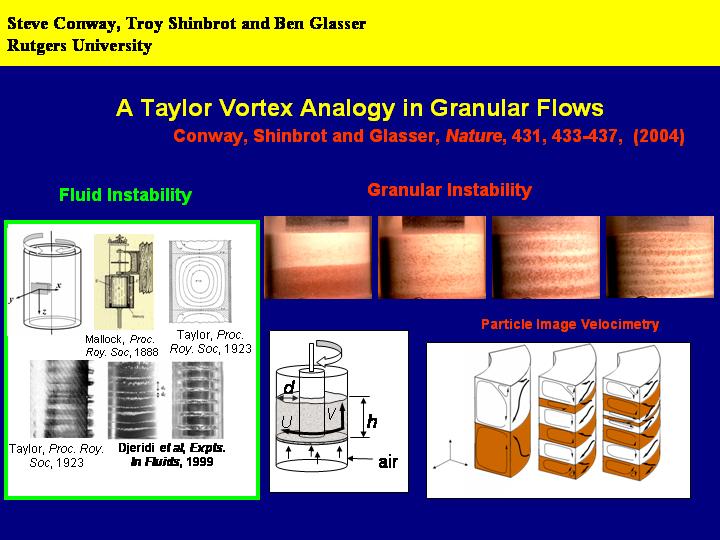
Fluids sheared between concentric rotating cylinders undergo a series of three-dimensional instabilities. Since Taylor’s archetypal 1923 study, these have proved pivotal to understanding how fluid flows become unstable and eventually undergo transitions to chaotic or turbulent states. Detailed investigation of these instabilities has been central to a comprehensive understanding of fluid flows and associated mixing and transport rates. In contrast, predicting the dynamics of granular systems—from nano-sized particles to debris flows—is far less reliable. Under shear these materials resemble fluids, but solid-like responses, non-equilibrium structures and segregation patterns develop unexpectedly. As a result, the analysis of geophysical events and the performance of largely empirical particle technologies might suffer. Such technologies include the production of pills or tablets, food processing and fertilizer production. Using gas fluidization to overcome jamming, the authors showed experimentally that granular materials develop vortices consistent with the primary Taylor instability in fluids. The series of photographs show patterns observed in side views of the gas- fluidized granular bed sheared in the Taylor–Couette geometry. As the inner cylinder rotational velocity, is slowly incremented a binary mixture of glass spheres spontaneously segregates into ordered, nearly axisymmetric bands, each consisting of a stripe of large red particles (460 microns) next to a stripe of small white particles (40 microns). Following the snapshots from left to right corresponds to increasing rotation rate of the inner cylinder. Particle image velocimetry suggests that each stripe consists of a vortex and the number of vortices increases as the inner cylinder rotation rate increases. The vortices observed in the fluidized granular bed are unlike those in fluids in that they are accompanied by novel mixing–segregation transitions. The vortices seem to alleviate increased strain by spawning new vortices, directly modifying the scale of kinetic interactions. These observations provide insights into the mechanisms of shear transmission by particles and their consequent convective mixing.
For more information see:
Conway, S.L., Shinbrot, T., and Glasser, B.J., (2004), A Taylor Vortex Analogy in Granular Flows, Nature, 431, 433-437.
This work has also been profiled in the news media. See profiles
